Are you trying to conceive or monitoring your cycle health? The Rapid Progesterone Test is an important test for confirming that you have successfully ovulated. It measures the key hormone essential for preparing the uterus for pregnancy. Discover your ovulatory status quickly and conveniently with our in-pharmacy rapid test.
This test is available for £50 at Veritas Pharmacy (SR4 7HG).
Harley Diagnostics
Benefits of Monitoring Your Progesterone Levels
Progesterone is the critical hormone that dominates the second half (luteal phase) of the menstrual cycle. Monitoring its peak level confirms ovulation and provides essential information for fertility and cycle health.
Confirm Ovulation
Scientifically verifies that a follicle released an egg and that your cycle is ovulatory.
Guide Fertility Treatment
Provides crucial data for timing conception efforts or adjusting fertility treatment plans.
Investigate Cycle Issues
Helps determine the cause of irregular periods, heavy bleeding, or premenstrual syndrome (PMS).
Early Pregnancy Support
Can be used to monitor hormone levels in the early stages of pregnancy to assess viability.
Harley Diagnostics
What Are the Symptoms of Low Progesterone?
Low progesterone levels, often caused by failure to ovulate or a short luteal phase, can lead to several noticeable symptoms and issues:
A consistently short time between ovulation and menstruation (less than 10 days).
2
Spotting Before Period
Bleeding or spotting that occurs several days before the menstrual flow begins.
3
Infertility
Difficulty conceiving due to an unsupportive uterine lining for implantation.
4
Recurrent Miscarriage
Low progesterone in early pregnancy may contribute to a lack of uterine support, leading to loss.
5
Severe PMS
Symptoms like irritability, breast tenderness, or mood swings that are significantly worse than usual.
6
Poor Sleep
Progesterone has calming effects, and low levels can sometimes contribute to insomnia or difficulty staying asleep.
How it works
How Does the Rapid Progesterone Test Work in Sunderland?
Our rapid test is a simple and effective way to measure your progesterone levels using advanced Point-of-Care technology. The test must be performed at a specific time in your cycle to be clinically meaningful (usually Day 21 of a 28-day cycle, or 7 days after confirmed ovulation).
A small blood sample is collected and applied to a special test card.
The test card is inserted into an analysis machine.
Results are provided within 15 minutes, right at the pharmacy.
The clinic may provide advice or refer you to your GP/fertility specialist, if necessary.
Overview
What does the test look for?
The test measures the concentration of the hormone Progesterone in your serum, measured in nanomoles per litre (nmol/L). Progesterone levels peak approximately 7 days after ovulation. Therefore, the test looks for the peak concentration to confirm that ovulation has occurred and that sufficient progesterone is being produced to support potential implantation. This is a quantitative test that indicates your progesterone level in nmol/L.
Your details will be confirmed by a member of the team performing the test.
2
Blood Collection
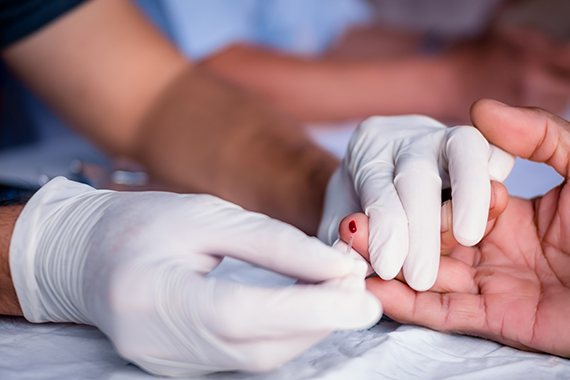
The professional will perform a simple and minimally invasive finger-prick to collect a small blood sample.
3
Rapid Analysis
The blood sample is analysed on-site using a special test card and a test analysing machine.
4
Results
You will receive your results in just 10–15 minutes, allowing for rapid insight into your progesterone status.
5
Advice
The clinic may provide advice or refer you to your GP, if necessary.
Harley Diagnostics
What do your Progesterone test results mean?
The rapid Progesterone test provides a quantitative result showing your hormone level (nmol/L), which is interpreted specifically based on the timing of your cycle (the luteal phase).
Progesterone Level (nmol/L)
Progesterone Level (ng/mL)
Classification
What do your results indicate?
Less than 16 nmol/L
<5
Not ovulated
The result suggests that ovulation has not yet occurred.
If the test was performed early in your cycle, repeat the test
in 5 to 7 days for confirmation.
16–30 nmol/L
5–9.44
Might have ovulated
Indicates possible ovulation, although the timing within your
menstrual cycle may have been premature. In such cases, repeating
the test after 5–7 days is recommended to accurately assess ovulation.
Above 30 nmol/L
>9.44
Ovulated
Indicates that you have ovulated.
Please be aware that different laboratories, manufacturers, and providers may use slightly different reference ranges. The reference ranges provided on this page are for general guidance only and represent commonly accepted clinical thresholds.
This rapid blood test is designed solely as an initial screening tool for triage and is not a substitute for a full lab-based venous blood draw. The results offer quantitative insights but are for informational purposes only and should not be considered a medical diagnosis. Any abnormal or significant result must be followed up with a medical assessment with your doctor and potential confirmatory lab-based testing.
The test is primarily used to confirm that ovulation has occurred in the menstrual cycle, which is essential for natural conception. It helps assess the health and length of the second half of your cycle.
When should I take the test?
The test must be taken during the luteal phase of your cycle—specifically, when progesterone is expected to be at its peak. For women with a typical 28-day cycle, this is usually Day 21 or exactly 7 days after you confirmed ovulation. Testing on the wrong day will give an inaccurate result.
Does this test diagnose pregnancy?
No. While high progesterone levels may be consistent with early pregnancy, the Progesterone test is not a diagnostic test for pregnancy. You must use a Human Chorionic Gonadotropin (hCG) test to confirm pregnancy.
Who should consider getting a rapid Progesterone test?
Anyone aged 18 or over who is trying to conceive, experiencing irregular cycles, or suspecting hormonal imbalances related to their cycle should consider this test.
Does the test require any special preparation, like fasting?
No, the test is a simple finger-prick blood test that does not require you to fast.
Is the test suitable for children?
The service is primarily for adults; therefore, we can only offer this test to those aged 18 years and over. Please consult with your GP if you are aged below 18 years old.
What is the Luteal Phase?
This is the second half of the menstrual cycle, starting after ovulation. It is governed by progesterone, which prepares the uterine lining for a fertilised egg. A healthy luteal phase is crucial for sustaining an early pregnancy.









.png)